Analysis into the opening title sequence in the film 'Halloween' (1978) Directed by John Carpenter.
This film is an independent American horror film which is set in a fictional suburban town called Haddonfield in Illinos - USA on the night of Halloween.
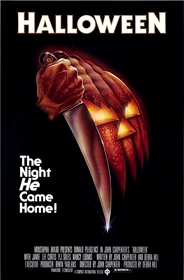 A Psychotic murderer who had been instiutionalized since their childhood years, manages to escape and embarks on a mindless rampage, while his doctor chases him through the streets!
Halloween was produced on a budget of $320,000 and grossed $47 million at the box office in the USA, equivalent to over $150 million as of 2008. This independent film has therefore become one of the most profitable in film history.
This film has been credited by critics as the first in a long line of 'slasher' films inspired by the 1960 film 'Psycho' by Alfred Hitchcock. This film created the origins of many cliches which are frequently found in low-budget horror films of the 1980's and the 1990's. Although this film does not actually contain much gore and graphic violence.
Mise en scene:
Opening titles fade in with the colour yellow (then fade to orange) the connotation of this is fire - flicker of the pumpkin candle the titles then and fade out with the colour red the connotation of this is horror, blood, violence, aggression. The titles are central with a black background the connotation being death, horror, fright. From the use of these colours, you can see that the genre of this film, before actually seeing anything, is horror. During the opening titles, a pumpkin comes into the image, positioned in the left hand side of the shot. A forward zoom is used for the pumpkin, which makes it gradually bigger and more in focus.
Opening titles fade in with the colour yellow (then fade to orange) the connotation of this is fire - flicker of the pumpkin candle the titles then and fade out with the colour red the connotation of this is horror, blood, violence, aggression. The titles are central with a black background the connotation being death, horror, fright. From the use of these colours, you can see that the genre of this film, before actually seeing anything, is horror. During the opening titles, a pumpkin comes into the image, positioned in the left hand side of the shot. A forward zoom is used for the pumpkin, which makes it gradually bigger and more in focus.
The clown costume worn by Michael is supposed to be a costume which you would associate with happiness and light-hearted fun, but the fact that Michael is the killer, gives the audience a kind of spooky, strange feeling.
Camera Angles:
 Subjective POV originates from ‘Psycho’ attack scene (Alfred Hitchcock).
Forward tracking (pov) up to the front of the house.
Forward zoom to the pumpkin in the opening titles.
Crane shot – sweeping back – reverse tracking, we see Michael - the killer, and the situation he is in.
A subjective point of view shot through Michael eyes is used up to the point of the death of his sister. This shot would have been executed through the use of a handheld camera or steadicam. When Michael's parents remove his mask, the pov camera shot is replaced by a medium long shot, showing his parents in shock. Reverse tracking is used to show Michael, his parents and the surroundings. This shot would have been created using a crane.
 Subjective POV originates from ‘Psycho’ attack scene (Alfred Hitchcock).
Forward tracking (pov) up to the front of the house.
Forward zoom to the pumpkin in the opening titles.
Crane shot – sweeping back – reverse tracking, we see Michael - the killer, and the situation he is in.
A subjective point of view shot through Michael eyes is used up to the point of the death of his sister. This shot would have been executed through the use of a handheld camera or steadicam. When Michael's parents remove his mask, the pov camera shot is replaced by a medium long shot, showing his parents in shock. Reverse tracking is used to show Michael, his parents and the surroundings. This shot would have been created using a crane.
The director, through the use of a subjective POV shot, makes the audience feel the illusion that the killer is perhaps a rival to the girl’s boyfriend, who is perhaps possessive. This is because the height of the POV shot would suggest that the killer is an adult. When Michael is revealed to be a child, the audience is confused.
Sound:
Parallel sound is used during the opening titles through the use of incidental music. The soon-to-be famous scary Halloween theme tune is used. This music compliments what we see on screen, it is a high-pitched screechy haunting sound, which makes the audience feel uneasy. The theme tune is known as diegetic sound which means that it has been edited onto the scene, and cannot be heard within the scene.
Parallel sound is used during the opening titles through the use of incidental music. The soon-to-be famous scary Halloween theme tune is used. This music compliments what we see on screen, it is a high-pitched screechy haunting sound, which makes the audience feel uneasy. The theme tune is known as diegetic sound which means that it has been edited onto the scene, and cannot be heard within the scene.
When the opening titles end, children’s happy voices are apparent, which overlap the haunting sound and gradually drown it out, therefore changing the feeling that the audience has, by replacing it with a sense of relief as the sound of happy children is usually associated with innocence and safety.
A screeching high pitch sound is apparent when Michael is walking around the house, which makes the audience feel uneasy and frightened.
The opening titles are editied with a fade effect, they slowly fade in and out, from the colour yellow, to orange then finally, to red.
Editing:
The opening titles are editied with a fade effect, they slowly fade in and out, from the colour yellow, to orange then finally, to red.
The editing throughout the clip is seamless which means that you cannot see the cuts.


No comments:
Post a Comment